
If you have seen this described as a Facebook algorithm change for small businesses, the source is Meta’s 13 March 2026 update to its original-content guidance for Feed and Reels. Meta said it was clarifying what counts as original and prioritising original work over unoriginal material. This is a specific content-guidance update, not a general formula for Page reach.
For a trade business, the practical takeaway is not “post every day” or “use this hashtag”. It is to show your own work and add real context. Meta does not publish a fixed formula that guarantees organic reach, and an update to recommendation guidance is not a promise that any individual post will generate enquiries.
What Meta changed in March 2026
Meta’s official announcement says content filmed or produced directly by the creator or owner of a Facebook Page or Profile is considered original. Selective use of third-party material can still be considered original when the creator adds something genuinely new, such as fresh information, analysis or a substantial improvement to a storyline.
Meta also says that simply watching along, reacting with facial expressions, stitching clips together or narrating what is already on screen without meaningful additions may be considered unoriginal and deprioritised in Feed and Reels. Duplicative content and minor edits to another creator’s post are also described as unoriginal.
This is a specific update to Facebook’s original-content guidance. It does not mean that every post with a shared image, a short caption or a link is automatically penalised. Read Meta’s wording directly and avoid turning a creator policy into an invented rule about all posts.
What the update means for a local trade business
Trade businesses can often create original material from their own work: job photos, explanations of completed work and answers to customer questions. A photo of a fence you installed, paired with a truthful note about the repair, is a useful starting point compared with reposting a competitor’s video.
Originality is not just pressing the camera button. Add the context that only you can provide: what the customer asked for, what condition you found, what options you discussed and what the finished work does. Do not reveal private details or make the post sound like a technical guarantee. A useful caption might say, “Replaced damaged boards along this garden boundary in [area]; the customer wanted to keep the existing posts, so we checked them before fitting the new panels.” Use that only if it accurately describes the job.
You can also make original advice posts from your experience. Explain what a homeowner can safely check before calling, when a site visit is needed and what information helps you prepare. Do not diagnose a fault from a single picture or tell someone to carry out unsafe work.
Your own cross-post is not the same as copying a creator
Meta’s announcement focuses on unoriginal material from other creators and low-value edits to their posts. It does not state that posting your own finished-job photo to both your Facebook Page and Instagram account automatically makes it unoriginal. If the work and image are yours and you have permission to publish them, you can share them across your own channels.
Still, review each destination. A Facebook group may have separate promotion rules; an Instagram caption may need different context; an image crop may hide a useful detail. Rework the caption when it helps the customer, rather than assuming a cross-post is wrong or that identical text will perform the same everywhere.
Do not download another business’s photo, add a border, change its speed or write a new caption and present it as your work. If you are discussing someone else’s public content, make your own contribution substantial, relevant and properly attributed where appropriate. Meta’s creator guidance says simple reactions or narration without meaningful additions can be deprioritised.
How Facebook ranking works—and what it does not tell you
Meta’s Facebook Feed ranking explanation describes recommendation systems that predict what each person may find interesting or engage with. The order of a person’s Feed is not a universal queue where every business Page competes under one simple score.
That means a post’s performance can vary between people and over time. Audience interests, interactions, the content itself and other system signals can affect what someone sees. Meta does not give small businesses a dependable public recipe such as “use exactly this number of posts per week to reach all local customers”.
The March originality update is also not the same as paid advertising guidance. An organic post, a Page recommendation and an advert are different surfaces. If you pay to promote a post, follow the current advertising rules and budget controls; do not assume the organic-content announcement guarantees paid results.
A simple original-content routine for trades
Collect potential content while doing normal work, but do not let photos distract from safety or customer service. With permission, take a clear before photo and a finished photo from a similar angle. Note the service, broad area and one useful detail. Store the job notes securely and leave out the customer’s full address.
Before publishing, check:
- Ownership: Is this your own photo, video or explanation, or do you have permission to use it?
- Accuracy: Does the caption describe this job rather than a generic promise?
- Privacy: Have you removed identifiable details the customer did not agree to share?
- Usefulness: Will a local customer understand the service and what to do next?
- Placement: Does the group, Page or account allow this kind of post?
For example, a short clip of a finished kitchen can show the result. Add a few original details in your own words: the work you completed, a design constraint you solved and the area you serve. If you share a manufacturer’s specification, identify it as the manufacturer’s information rather than claiming it as your own testing.
What the update does not say
Meta’s announcement is about originality and recommendation distribution on Facebook Feed and Reels. It does not publish a guaranteed reach formula, say that every business Page must make video, set a mandatory posting frequency or promise that original work will turn into sales. The system still decides what an individual viewer is likely to find relevant, and its explanations can change.
It also does not say that every use of a third-party element is forbidden. Meta describes some selective use as original when a creator adds a new on-screen contribution, such as fresh information or analysis. A tradesperson sharing a supplier’s brochure image is not the same as producing an original job demonstration, though the business must still respect copyright and any usage terms. When unsure, use your own image and describe your own work.
The update is specific to Facebook’s content guidance. Do not assume that it rewrites every Instagram recommendation rule, every advertising policy or the terms for a local community group. Check the rules for the exact surface where you are posting, especially before using customer images, copyrighted music or content supplied by another person.
What a small business can do next
You do not need a production crew. With permission, share your own job photo or clip and explain what the customer needed, what you completed and the area you serve. Keep safety advice within your competence and leave confidential details out.
If you use a caption template, add verifiable job details instead of posting identical generic wording. Use another person’s footage only when you have the rights and add meaningful context where appropriate. The goal is useful original proof, not a trick to game ranking.
Review a post without chasing a secret formula
Check the available Page insights after posting, but do not use a single day’s reach as proof that the content was good or bad. Look at whether the post reached relevant people, whether they visited your profile or asked a suitable question and how much time it took to create.
Record enquiries and booked jobs separately from reactions. A homeowner may remember a post and call weeks later, while another viewer may like it without needing your service. Ask new customers how they found you and note multiple influences when they mention a referral and a Facebook post.
If a post performs poorly, improve the next one based on a real issue: unclear service, weak photo, no local context or an unanswered message. Do not respond by copying viral material, stuffing unrelated hashtags into the caption or buying engagement.
For examples of useful Page captions, see how to write a Facebook post for tradesmen. If you are deciding which Meta platform deserves more time, use our Instagram vs Facebook comparison. For caption tags, see the guide to hashtags for UK tradesmen.
What to watch next
Platform guidance can change. Check Meta’s Newsroom and creator help pages when you plan a campaign, especially if you rely on a specific feature or content format. Treat third-party posts claiming “the algorithm now hates photos” or “every Page must post Reels daily” with caution unless they link to a current official explanation.
The sustainable response to this Facebook algorithm change for small businesses is straightforward: make work you can stand behind, publish material you own or have permission to use, add useful context and keep the business details accurate. No formula replaces relevance to the customer.
For a practical caption structure to use with original job photos, see how to write a Facebook post for tradesmen. Keep the focus on useful proof and accurate details, not on predicting a secret formula.
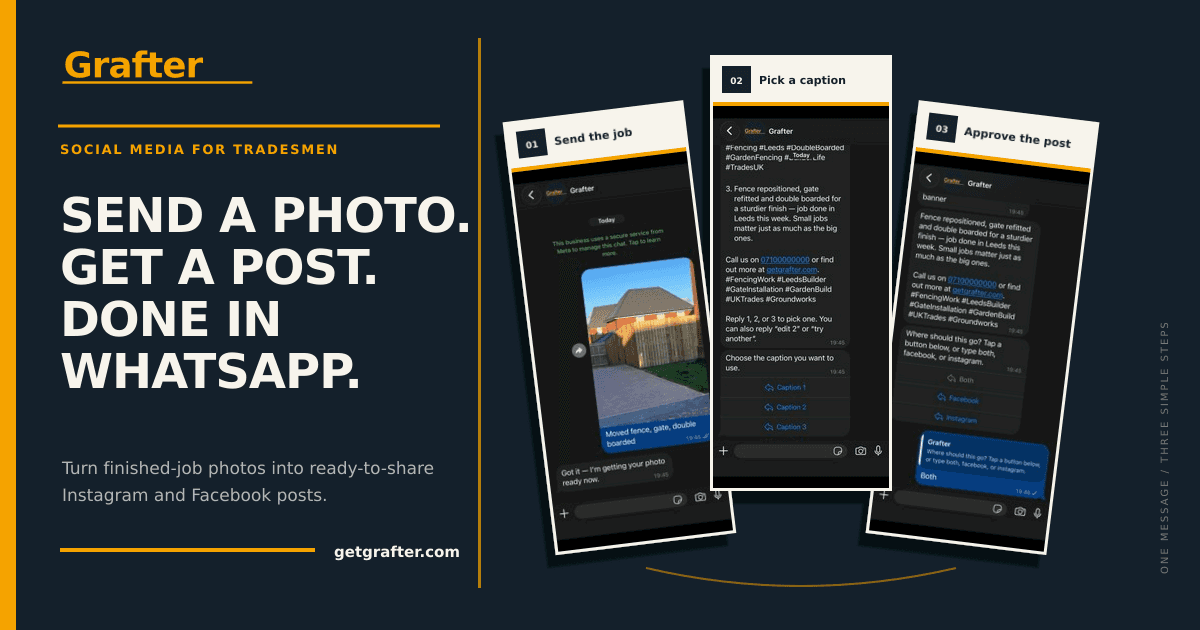
If you want help drafting captions from real job photos, Grafter lets you send a photo and a sentence over WhatsApp, review the options and decide what to publish. Try Grafter on WhatsApp.