
AI marketing for tradesmen is becoming practical because many small firms have the raw material—job photos, service notes and common customer questions—but not the time to turn it into useful marketing. An AI tool can help produce a first draft or organise ideas. It cannot inspect the job, confirm a qualification, promise an accurate price or take responsibility for what gets published.
The strongest use is assistance, not autopilot. Give a tool a clear task, keep customer information safe, check the result against what actually happened and decide yourself whether it is fit to share.
What AI can do in a trade business
Some tools generate text from a prompt, some can summarise information and others help organise or schedule content. The specific capabilities depend on the product and its current settings. For a small trade business, useful tasks are usually narrow and repeatable:
- Turn a short job note into a first caption draft.
- Suggest several ways to explain one service in plain language.
- Create a list of common customer questions to answer on a website.
- Rewrite a draft to be shorter, clearer or less technical.
- Organise a month of content ideas around real jobs and seasonal services.
- Prepare a checklist for collecting photos and notes after a job.
These tasks reduce blank-page friction; they do not establish whether the facts are true. If you type “fit new consumer unit in [town]” and the tool adds a brand, guarantee or certification you never mentioned, the output is wrong even if it sounds polished.
Start with a small, verifiable task
Choose a task where you can check the result quickly. A caption for a completed job is a good example if you provide only details you are comfortable sharing. Ask for plain English, a short draft and a clear next step. Then compare every line with the job record.
For example, a prompt might say: “Write a short Facebook caption using only these facts: replaced two damaged fence panels in [broad area]; reused the sound posts; customer gave permission to share this photo. Do not add a price, warranty or claim about how long the repair lasts.” The draft still needs review, but a clear boundary reduces the chance of invented detail.
Do not ask a general chatbot to diagnose an electrical fault, assess a roof from one image or confirm that a job meets a regulation. Those decisions require qualified judgement, proper inspection and current technical information. AI-generated wording is not a substitute for a site visit, manufacturer instruction or professional standard.
Use AI for drafts, not customer promises
AI can produce confident-sounding text that is incorrect, outdated or too broad. Check:
- Services: Does the business actually perform this work?
- Qualifications: Is every certificate, registration and accreditation accurate and current?
- Prices: Does the figure reflect your quote, including what is and is not included?
- Availability: Is the stated appointment or offer still open?
- Technical advice: Is it safe, current and within your competence to provide?
- Location: Does the business genuinely cover the town named?
Do not allow a tool to invent customer testimonials, before-and-after results, reviews or a case study. Do not let it turn a cautious service description into a guarantee. If you cannot verify a claim, remove it or check it against an authoritative source before publication.
Protect customer information and photographs
A job photo may contain more than the finished work: a house number, family member, vehicle plate, paperwork, alarm panel or an image that reveals when the customer is away. Review the image before posting or uploading it to a tool. Ask permission before taking or publishing identifiable photos of a customer’s property.
Before using an AI service, read its current terms and privacy settings. Check what happens to prompts and uploads, how long they are retained, whether they may be used to improve the service, who can access them and whether you can delete them. These terms differ between providers and account types; do not assume that one tool’s settings apply to another.
Share the minimum information needed for the task. Use a broad area rather than a full address, remove names and phone numbers, and avoid uploading contracts, invoices, access codes, security details or confidential customer correspondence. If you need to process identifiable information, make sure you understand your responsibilities and have appropriate permissions and safeguards.
The Information Commissioner’s Office publishes guidance on AI and data protection. Its guidance pages note that some material is under review following changes to data-protection law, so check the current version or seek professional advice for a specific situation.
Do not automate unsolicited marketing
Using AI to write a message does not make the message appropriate to send. If you use personal details to target a named customer, or plan to send marketing by email, text or social message, check the rules for that channel and the purpose of the communication. The ICO’s small-business direct marketing guide explains that direct marketing can include messages and targeted online activity; the page also says its guidance is under review.
Keep service updates separate from promotional messages and do not upload a customer list to an AI system just because it offers to write a campaign. Confirm you have the right to use the data, understand the provider’s handling terms and give people the choices required by the relevant rules. When in doubt, get current advice before sending.
Use AI to make your marketing more specific
Generic copy is easy to produce and easy to ignore. Instead of asking for “a viral post for my trade business”, supply real context: the service, the problem solved, the broad area, one detail about the work and the type of customer you want to reach. Remove private information and ask the tool not to add unsupported claims.
Then edit the text so it sounds like the business. Use the words your customers use, not a string of SEO phrases. Explain what they can do next: send a photo, call during working hours or arrange a site visit. Do not promise a remote quote if the job needs inspection.
For example, a kitchen fitter might turn a job note into a short post about protecting the floor and working around an existing appliance. An electrician might draft a checklist of questions a customer can prepare before requesting a visit, without offering instructions for unsafe electrical work. The value comes from your accurate experience, not from the model’s generic fluency.
Build a human review step into the workflow
Keep a simple process:
- Choose the purpose: explain one service, share a real job or answer a genuine question.
- Remove unnecessary data: omit names, precise addresses and confidential details.
- Give the tool verified facts: include only details you can confirm.
- Generate a draft: request a clear length and tone, not a guaranteed outcome.
- Check every claim: compare names, places, dates, prices and technical wording.
- Review privacy and permission: confirm the image and customer details can be shared.
- Approve or discard: publish only if it is accurate and useful.
Keep the final version and the original job note if you need a record of what was said. If a customer points out an error, correct it promptly. Never treat “the AI wrote it” as an excuse for misleading advertising.
Measure the benefit honestly
AI may reduce the time it takes to draft a caption, but the amount varies with the task, the tool and how much editing is needed. Time the full workflow: prompt writing, fact checking, editing, customer permission and publishing. Compare it with the method you already use.
Also track whether the content leads to suitable enquiries, not only whether drafts are produced faster. A caption that saves five minutes but attracts the wrong jobs may not help the business. If a simple template or saved note works better, use that instead. The point is to make a reliable process easier, not to use AI for its own sake.
Combine AI with a real trade portfolio
AI cannot replace a clear service page, permission-cleared photographs, current contact details or a professional response. Keep these basics in place. A customer who finds a generated caption still needs to know what the business does, where it works and how to ask a question.
For the practical side of choosing content, see what tradesmen can post on social media and how to write a Facebook post for tradesmen. Our beginner’s guide to social media for tradesmen covers a manageable routine.
Before adopting a tool across the business, test it on a low-risk task and compare the final result with your usual process. Note the time spent prompting, editing and checking, and whether the output needed correction. If it regularly invents details or produces copy that does not sound like you, narrow the task, improve the input or stop using it for that purpose.
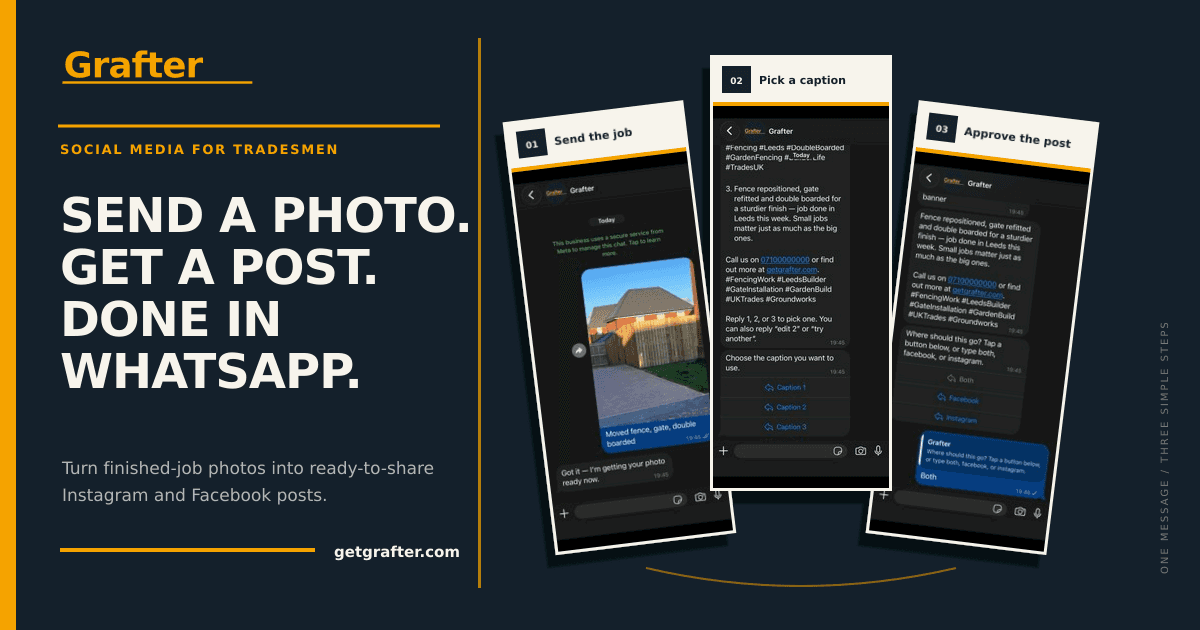
Grafter is one example of a focused AI-assisted workflow: send a job photo and a sentence over WhatsApp to receive caption options for Facebook and Instagram. You still review the details and choose whether to use the draft. That division matters: AI can help with the first draft, while you remain responsible for the work, the facts and the customer relationship. Try Grafter on WhatsApp.