
Searching for the best hashtags for tradesmen can lead to giant copy-and-paste lists. For UK tradesmen, a long block of tags is not a marketing plan, and no hashtag guarantees that a nearby customer will see your post. The useful approach is to choose a few accurate tags, make the caption clear and use the actual town or trade only when it fits the job.
Hashtags can label a post and connect it to a topic people browse. They work alongside the photo, caption, profile and platform search—not instead of them. Use them as signposts, not as a promise of reach.
Start with the post, not the hashtag list
Before adding any tags, write one plain sentence describing the work. Include the service, a broad area if appropriate and one detail that helps a customer understand the result. For example: “Replaced three damaged fence panels in [town] and checked the posts before fitting the new panels.”
That sentence is more useful than a pile of tags because it tells both people and the platform what the post is about. Do not rely on a hashtag to explain whether the image shows a roof repair, a kitchen installation or a general building project. If a potential customer cannot tell what you do from the caption and profile, extra tags will not fix the gap.
For examples of captions built around a job and a clear next step, see how to write a Facebook post for tradesmen.
A simple hashtag mix for a trade post
Choose tags from a few relevant types:
- Trade: identifies the service, such as a builder, plumber or electrician.
- Job type: describes the actual work, such as fencing, bathroom fitting or roof repair.
- Location: names the town or region you genuinely serve.
- Brand: optional, if customers already know and use your business name.
You rarely need every type on every post. A kitchen fitter posting a kitchen transformation might use a trade tag, a kitchen-related tag and a location tag. A small plumbing repair may need only a plumbing tag and the local area. Choose the tags a likely customer could understand; do not add a builder tag to an unrelated garden project simply because it is popular.
Hashtag ideas by trade
Use these as starting points, not as a guaranteed ranking list. Replace [town] with the real place or a natural local area tag, and check that the tag is being used for relevant work before adding it.
- Builders:
#UKBuilder,#BuildingWork,#[Town]Builder,#HomeRenovation - Electricians:
#ElectricianUK,#ElectricalWork,#[Town]Electrician,#LightingInstallation - Plumbers:
#PlumberUK,#PlumbingWork,#[Town]Plumber,#BathroomInstallation - Roofers:
#RooferUK,#RoofRepair,#[Town]Roofer,#RoofingWork - Fencers:
#FencingContractor,#FenceInstallation,#[Town]Fencer,#GardenFencing - Kitchen fitters:
#KitchenFitter,#KitchenInstallation,#[Town]Kitchens,#KitchenRenovation - Landscapers:
#LandscaperUK,#GardenLandscaping,#[Town]Landscaper,#GardenDesign
The placeholder is not a usable hashtag; replace it with a joined-up local phrase such as #YorkBuilder if that accurately describes your area. Some local tags may have few posts, while broad tags can be crowded or used for unrelated content. Search the tag first and decide whether the posts there are relevant to your customers.
Instagram hashtag limits and practical use
Instagram Help currently says you can use up to five hashtags on a post. It also explains that hashtags link to pages of tagged photos and videos, with visibility affected by account and post settings. Check the current Instagram hashtag instructions if the interface changes.
Use the limit as a reason to edit carefully, not to cram in five tags by default. If only two tags fit the job, use two. Put the useful service and location words in the caption itself as well. Instagram’s search guidance has advised creators to use relevant keywords and hashtags in captions so posts can be found through search.
Avoid unrelated trending tags, repeated blocks that have nothing to do with the photo, and strings of near-identical spellings. They can make the post look careless and attract the wrong audience. Never add a tag that implies a qualification, certification or service you do not have.
What about Facebook hashtags?
Facebook and Instagram are not the same search surface. A tag may be clickable on Facebook, but a local customer may be more likely to understand a direct description, Page details, group recommendation or shared post than a long hashtag block. Keep Facebook tags modest and relevant if you use them; do not assume that more tags create more distribution.
Use a local place name naturally in the caption and keep the Page’s service area accurate. When posting in a community group, follow the group’s rules; hashtags do not make an advert permitted if the rules prohibit promotion. For a wider platform comparison, read Instagram vs Facebook for trade businesses.
Combine tags with useful photos
A hashtag cannot rescue a dark, confusing or misleading image. Show the actual finished work, choose a clear angle and remove private details from the frame. If you post a before-and-after pair, label the images and make sure both relate to the same job. Ask permission before sharing a customer’s home.
Add a short explanation of the job and the detail that matters. “New kitchen installed in [area]” is a start; “New kitchen fitted in [area], with the old units removed and the existing floor protected during the work” gives a prospective customer more context, provided it is accurate.
Our before-and-after photo guide explains how to capture proof without turning every job into a photo shoot. A few well-chosen images with specific descriptions make a more useful portfolio than a stream of unexplained pictures.
Make hashtags part of a repeatable routine
Keep a small note on your phone with a few accurate trade and location tags for the services you actually offer. Review it every so often: remove tags that no longer fit, add a new service only when you genuinely take that work and check whether local tags still show relevant posts.
For each post, ask three questions:
- Does this tag describe the work shown?
- Would a potential customer understand it?
- Is the location real and within the area I serve?
If the answer is no, leave it out. If you use a business-name tag, spell it consistently and do not expect customers to search for it before they have heard of you.
Measure the right result
Do not judge hashtags only by likes or the number shown beside a tag page. Platforms change their recommendation and search systems, and customers may see a post without clicking a hashtag. Instead, watch for relevant profile visits, messages and enquiries. Ask new customers how they found you and record the answer.
If a post gets attention from outside your area but no suitable enquiries, change the content or local wording rather than adding more generic tags. If people do not understand your service, make the caption and profile clearer. Keep one variable steady while testing another so you can tell what changed.
Build a few small sets you can edit
Create a short note for the jobs you take most often rather than one enormous list. A builder might keep separate sets for extensions, repairs and kitchen renovations; a plumber might group bathroom fitting separately from heating work. Add the local area only when the job took place there or the service is genuinely available there. This makes it less likely you will attach an irrelevant town or service tag in a hurry.
Before reusing a set, check the post itself. A tag for “new build” does not fit a repair; a kitchen tag does not fit a bathroom. If the work crosses trades, choose tags that describe the service you actually delivered rather than tagging every contractor who might have been involved. Do not use a customer’s name or a private address as a hashtag.
Keep the note small enough to review. Remove spellings that are difficult to read, tags that lead to unrelated material and local variants that do not describe your normal service area. If you add a new service, make sure the business really takes that work before adding it to every caption. A saved list should speed up editing, not replace it.
Common hashtag mistakes
Avoid copying a competitor’s entire caption, tagging towns you do not serve, using a popular tag because it is trending or adding a string of variations such as singular and plural forms of the same phrase. Do not use tags to imply a review, endorsement or trade qualification that is not genuine.
Most importantly, write for a customer first. The best hashtags for tradesmen are the few accurate labels that support a clear post about real work. They are one small part of being easy to find, not a shortcut around a strong profile, useful proof and a good response.
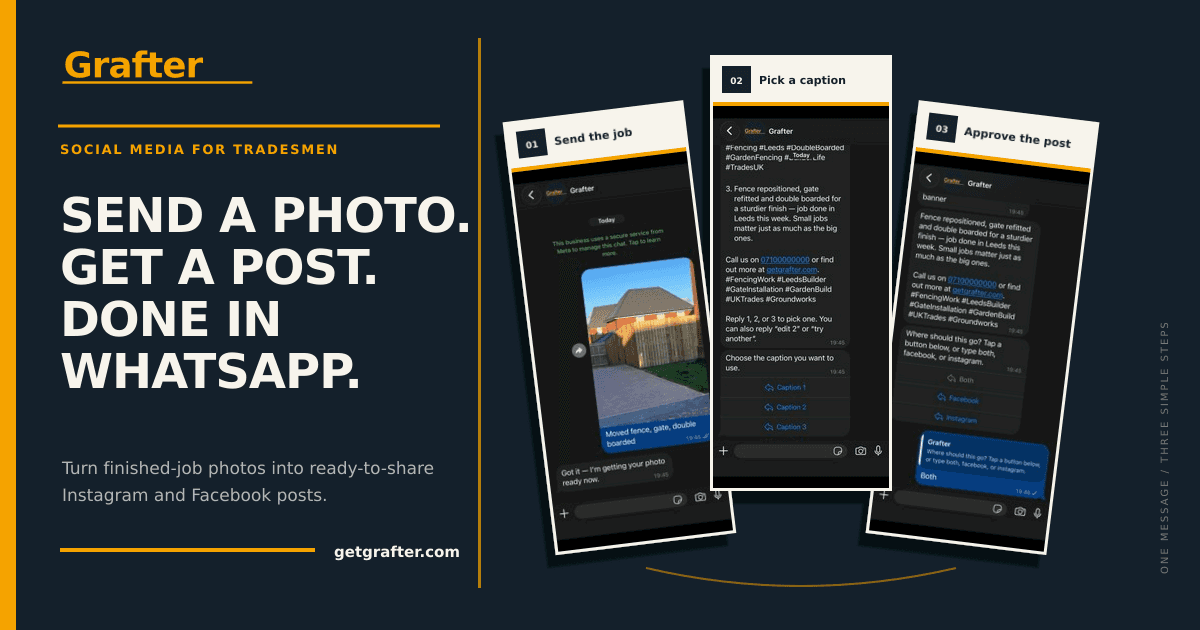
If writing captions and selecting a handful of relevant tags is the part you struggle to fit in after work, Grafter can draft options from a job photo and a sentence over WhatsApp for Facebook and Instagram. Review each caption before it goes out. Try Grafter on WhatsApp.