When you search for “Instagram vs Facebook for tradesmen”, the useful question is not which platform is universally best. It is where your likely customers already look, what proof of your work you can share and which channel you can maintain while running jobs.
Facebook and Instagram are both Meta platforms, but customers may use them differently. Facebook can support local Page discovery and community conversations; Instagram is built around visual posts, Stories and Reels. Neither promises a steady stream of leads. A simple test using your own enquiries is more reliable than choosing based on someone else’s follower count.
Start with your customers and your work
Write down the jobs you want more of and the areas you can serve profitably. Then think about how a customer might look for that work. They may ask a neighbourhood group for a recommendation, search for a local business Page, browse photos of kitchens or gardens, or follow a friend who has just had similar work done.
Your trade also affects the kind of proof you can show. A kitchen fitter may have strong before-and-after images. An electrician may show a neat installation detail or explain a common safety check without offering a remote diagnosis. A plumber may share a completed bathroom or a simple maintenance reminder. You do not need to force every job into a polished “reveal”.
Keep the customer’s privacy in mind. Ask before photographing a home, avoid visible addresses and personal documents, and share only work you are entitled to show. Our before-and-after photo guide has a practical capture checklist.
What Facebook can do for a local trade business
A Facebook Page provides a place to show your business name, services, contact route, work examples and customer updates. Local groups can also be useful when their rules allow business recommendations or promotional posts. A customer may ask neighbours for a roofer, see a recommendation from someone they know and then check your Page before contacting you.
That path is not guaranteed. Group visibility depends on each group’s rules and how people use it. Some communities restrict adverts to a weekly thread; others allow recommendations but not direct promotion. Read the rules, contribute only where relevant and never use fake accounts to recommend yourself.
Facebook can also help you keep in touch with existing customers and people who already know the business. A post about genuine availability, a recent job or a service you provide gives them something useful to pass on. Do not assume a Page post will be shown to every follower.
What Instagram can do for a trade business
Instagram makes a visual portfolio easy to browse. The grid can show a range of completed work; a Reel can show a transformation or process; Stories can share timely updates. A visitor can scan several examples before deciding whether your style and services might fit their job.
This suits businesses with clear visual results, but every trade can show useful evidence. A close-up of a tidy finish, a short explanation of how you protected a customer’s home or a progress image can communicate care and workmanship. Explain the context in the caption so the viewer does not have to guess what the photo shows.
Use your profile description to state the trade, broad service area and a clear way to enquire. Instagram’s recommendation eligibility rules can change, so check the current Instagram creator guidance on recommendations instead of relying on old “growth hacks”. Being eligible for recommendations is not a guarantee that a post will be recommended.
Compare the work involved
Think about the complete job of using each platform: preparing a photo, writing a caption, publishing it, replying to comments and checking messages. A channel is not low-effort if enquiries arrive somewhere you never check.
Facebook group posts may need a more direct local explanation and careful attention to group rules. Instagram may reward a tidy, browsable set of photos and short videos, but it still needs captions, profile details and replies. Both platforms require sensible privacy checks and real descriptions.
Meta Business Suite offers tools to create and schedule posts for Facebook and Instagram. Its current posting guide explains the available account options. Scheduling helps you prepare content in a batch; it does not make the same caption equally suitable for every placement. Review the crop, wording and destination before publishing.
Adapt a post instead of copying it blindly
The same completed-job photo may work on both platforms, but the presentation can differ. A Facebook caption might say what service you completed, the area and how a nearby customer can ask about similar work. An Instagram caption can lead with the visual result and use a concise explanation of the process.
For example, a Facebook post might read: “Repaired a section of garden fencing in [area] after the old panels came loose. If you need a similar repair, message the Page with your postcode area and a photo.” An Instagram version might start: “Old panels out, straight run back in.” Then add the location, useful job detail and a clear contact route. Replace placeholders with true details and get permission to share the property.
Avoid uploading another contractor’s images or making minor edits to someone else’s content and presenting it as your own. Meta’s guidance on original content for Facebook says content produced by the Page or creator is original, while duplicative material and minor edits to another creator’s post can be treated as unoriginal. Your own work is your strongest proof.
For a caption structure that works across channels, use our Facebook post guide for tradesmen.
Choose one platform first if time is tight
If maintaining two accounts feels like another job, begin with the one that matches your customers and your available proof. Complete the profile, publish a few useful examples and decide how you will answer enquiries. A neglected profile with old hours and unanswered messages can undermine the trust the photos were meant to build.
After a few weeks, ask new customers how they found you. Keep a note of the channel, job type, area, whether you sent a quote and whether it became booked work. If nobody mentions a platform, that does not prove it had no influence, but it is better evidence than assuming likes equal jobs.
Run a simple 30-day comparison
If you have capacity, test both channels for a month without paying to promote every post. Use comparable examples of work and a similar level of effort. Keep the service, area and enquiry instructions clear. You do not need to post the same number of times if one format takes longer; record the time too.
At the end, compare:
- Suitable enquiries, not every message.
- Quotes requested and jobs booked.
- Time spent creating posts and answering messages.
- Whether customers were in the areas you actually serve.
- The types of jobs people asked about.
If one platform brings more relevant conversations, keep it in the routine. If both help, use both with a realistic publishing pace. If neither does, check that customers can understand what you offer and contact you easily before concluding that social media is useless.
When neither platform should be your first priority
Social media is only one part of getting found. If your business information is missing or inaccurate on search listings, customers may struggle to confirm your service area or contact you after seeing a recommendation. If customers mainly choose a trade through a landlord, builder, property manager or repeat contract, strengthen those professional relationships too.
Make sure the foundations are sound before adding more posts: a working phone number, a clear voicemail, an up-to-date service description and a way to respond while you are on a job. A social account cannot compensate for unanswered enquiries or unclear terms. If you are not eligible for recommendations or do not have permission to share customer work, use other accurate ways to explain your services rather than forcing content.
Some businesses also have compliance or safety reasons to be cautious about images, locations and customer stories. Check permissions, remove identifying details and keep a record of what you agreed to share. A smaller portfolio that respects customers is better than a larger one built from images they did not approve.
Common mistakes when choosing
Do not pick a platform because a competitor has many followers. Those followers may live outside your service area or want a different type of work. Do not post only polished large projects if small repairs are the work you want. Do not chase every feature update or pay for followers; neither guarantees customer demand.
Avoid treating the choice as permanent. Your work mix, customer habits and time available can change. Review the results occasionally, keep profile details current and shift effort when the evidence changes.
Instagram vs Facebook for tradesmen is really a choice about fit: customer, proof, time and follow-up. If you can show real work and answer the people who respond, either platform can support a wider local marketing plan.
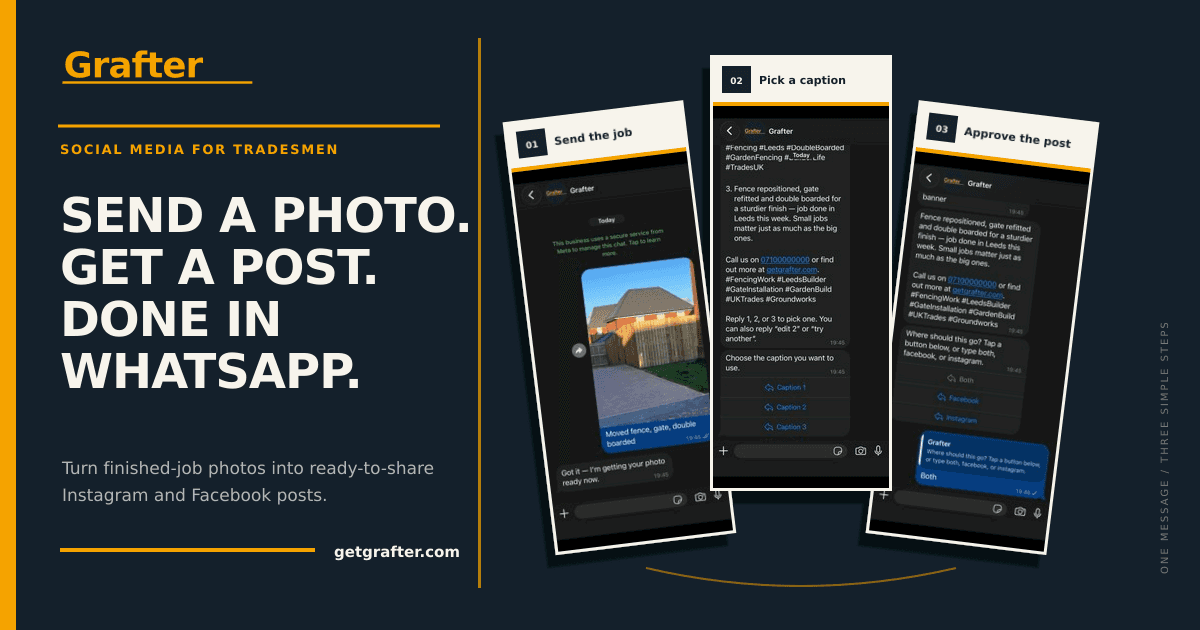
If drafting captions is what stops you using the photos you already take, Grafter can create options for Facebook and Instagram from a job photo and a sentence over WhatsApp. You approve the wording before posting. Try Grafter on WhatsApp.