
A good Facebook post for tradesmen is not a hard sell or a list of every service you offer. It is a clear piece of evidence: what you did, roughly where you did it, what mattered about the job and how a local customer can ask about similar work.
No caption can guarantee a booking or a particular amount of reach. The aim is more modest and more useful: make it easy for someone who needs your trade to understand your work and take the next step.
Start with the job, not an advert
Choose one completed job and one detail that makes it worth showing. That might be a repaired leak, a new set of kitchen units, a fence replaced after storm damage or a careful finish around awkward pipework. Use your own photo where possible and describe only what it shows.
Avoid leading with “We are the best in the area” unless you can substantiate a specific claim. A customer can judge a real result more easily than a boast. If the work involved a useful choice—such as matching an existing finish or protecting a garden—explain it in plain English without turning the post into a technical report.
Use a simple caption formula
Try this four-part structure:
- Job: Name the service or result in the first sentence.
- Area: Mention the town or broad area if it helps a local customer understand where you work.
- Detail: Add one relevant detail about the work, material or constraint.
- Next step: Tell an interested person how to enquire.
For example: “Replaced a run of damaged fence panels in [area] this week. We checked the posts before fitting the new panels, so the repair matched the condition of the rest of the fence. Need a similar repair? Send the business a message with your area and a photo.” Replace the brackets with details that are true. Do not publish the customer’s full address.
For a more detailed look at choosing content, see the beginner’s guide to social media for tradesmen.
Show the evidence clearly
A clear photo usually needs little explanation. Take it in decent light, hold the phone steady and check that the finished work—not a pile of tools or a van registration—is the main subject. If you have a genuine before-and-after pair, match the angle as closely as you can and label which image is before and which is after.
Ask the customer before photographing or posting their property, especially inside a home. Check the frame for faces, children, house numbers, alarm panels, paperwork and other identifying details. If the customer prefers not to be shown, respect that. You can photograph a close-up of the work or use a different job instead.
Do not use filters or edits that conceal faults or make the result look materially different. A natural photo that shows a real job helps set an honest expectation for the next customer. Our before-and-after photo guide explains how to capture a useful comparison.
Facebook post ideas that fit a trade business
You do not need a dramatic renovation for every post. A small, well-explained repair shows the kind of work customers often need. A progress photo can show how you protect a home or keep a site tidy. A short “what to check before you call” tip can answer a common question without pretending to diagnose a fault from a photo.
Other useful formats include:
- Finished job: State the service, area and one detail about the result.
- Before and after: Explain what changed and what the photos do not show.
- Process: Show a safe, non-sensitive step that helps customers understand the work.
- Availability: Share genuine dates or openings, and remove the post when they are filled.
- Customer feedback: Quote a real review only with permission, and keep its wording and meaning intact.
- Seasonal reminder: Mention a timely service such as checking an outdoor tap before frost, without implying an emergency where none exists.
Do not make every post an offer. A feed full of “book now” messages gives people little reason to follow or remember your page.
Write calls to action that reduce effort
“Get in touch” is understandable, but you can help a potential customer send the information you need. Ask for a broad area, a short description and a photo if that is appropriate for the trade. Explain that a site visit may still be needed before giving a firm quote.
For example: “If you need a similar repair in [town], message the Page with your postcode area and a photo. I can let you know whether it is work I cover and what information I need to price it.” This does not promise an instant quote or make a diagnosis from an image.
Use the Page’s current contact buttons and check that messages are being monitored. If you prefer phone calls, say when you are normally able to answer. Do not put a personal mobile number in a public post unless you are comfortable receiving calls from anyone who sees it.
Use a Page and groups appropriately
A Facebook Page gives your business a public place to show contact details, services and posts. Local groups can help you reach residents, but the group administrator sets the rules. Some groups allow a weekly advert; others permit recommendations but ban direct promotion. Read the rules every time you join a new group and do not assume that because a post was allowed elsewhere, it is allowed there.
When someone asks for a recommendation, answer relevantly and transparently. Do not create fake accounts to recommend yourself, pretend to be a customer or repeatedly post the same promotion. If you receive a question in a group, give a useful public answer where appropriate rather than immediately sending a private sales message.
Meta’s tools can change, and Facebook decides how posts are distributed. Use Meta Business Suite’s current help for creating and managing posts if you want to schedule Page content. Scheduling saves time; it does not guarantee reach.
Keep captions original and useful
Meta’s March 2026 guidance says content produced directly by a Page or creator is considered original on Facebook. It also says that duplicative posts or minor edits to someone else’s content may be treated as unoriginal and deprioritised in Feed and Reels. For a trade business, the practical answer is simple: use your own photos, explain your own job and add useful context rather than reposting another contractor’s picture.
If you share a manufacturer’s product information, make clear what is the manufacturer’s claim and what you personally observed. Do not copy a competitor’s caption, use a customer’s photo without consent or present stock imagery as a completed job.
Choose a manageable posting routine
There is no magic number of posts per week that guarantees leads. Pick a routine that fits the work diary. You might set aside ten minutes on Friday to choose one photo and write a caption, or collect a few images during the week and publish only when you have permission and a useful description.
Batching can help, but leave time-sensitive availability posts flexible. If a planned post mentions a date, offer or open slot, review it before it goes live. An outdated “space available next week” post can make the business look careless.
For a job with several stages, choose the update that will help a customer understand the work rather than uploading every image. A single progress photo can explain how you protected a room or prepared a surface; the finished photo can show the result later. Check that each image belongs to the same job and do not describe a planned stage as complete. This keeps a small business page useful without asking you to document the entire working day.
Learn from the right signals
After a few weeks, check which posts led to profile visits, messages, calls or useful conversations. A photo may receive few visible reactions and still be remembered by a future customer. Likes alone do not show whether the right person saw the post or whether they can afford and need the work you want.
When a new enquiry arrives, ask politely how the person found you and record the answer. Compare suitable enquiries and booked work, not just reach. If posts get attention but no messages, improve the service description or call to action. If enquiries are unsuitable, be clearer about the area, minimum job size or type of work you take on.
Avoid these common mistakes
Do not post the same generic advert repeatedly, publish an address without permission, make claims you cannot support or argue with a commenter in public. Avoid putting a long price list in a caption when every job depends on a site visit. If a customer raises a genuine concern, respond calmly and take private details to a direct conversation.
Most importantly, keep the post accurate. A useful Facebook post for tradesmen sets a realistic expectation: what you can do, where you work and what a customer should send next.
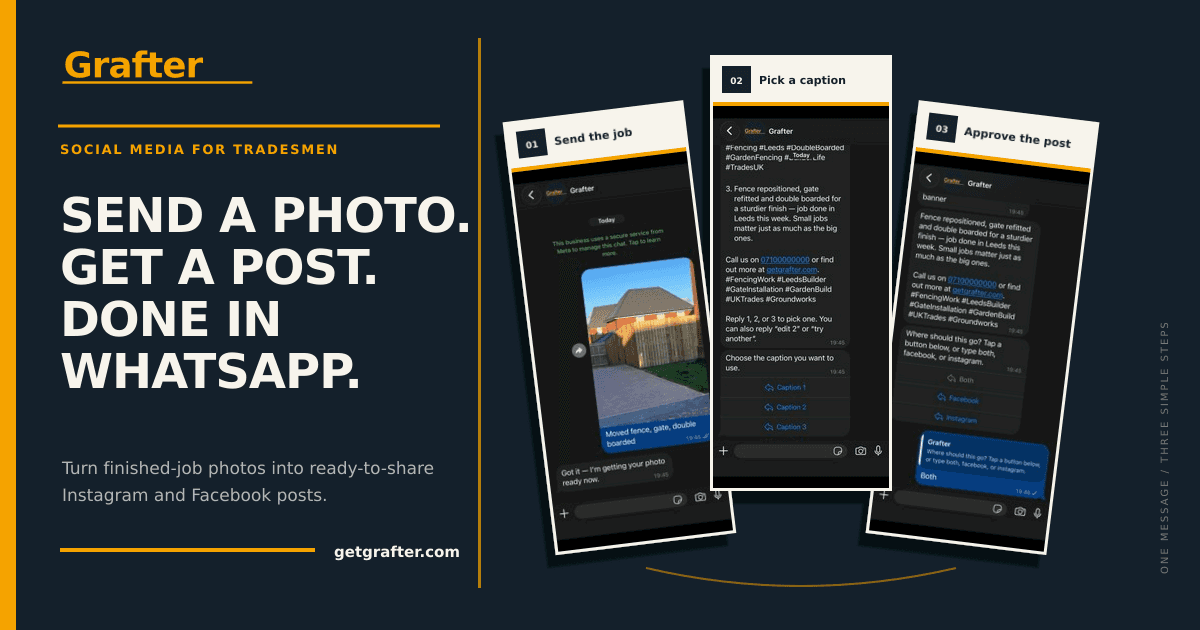
If writing the caption is the part that gets postponed after a full day on site, Grafter can draft options from a job photo and a sentence over WhatsApp for Facebook and Instagram. You review the wording before anything is posted. Try Grafter on WhatsApp.