
Local SEO for tradesmen is about helping nearby customers understand what work you do, where you genuinely take jobs and how to contact you. It is not a trick for forcing your business to the top of Google. Google says local results are mainly based on relevance, distance and prominence, and that no one can request or pay for a better local ranking.
The useful work is within your control: keep your business details accurate, explain your services clearly and make it easy for a customer to check your work. Here is a practical starting point for a UK trade business.
Start with the work and area you actually cover
Write down the services you want to be found for and the places where you regularly accept jobs. Be specific. “Boiler servicing and heating repairs within 20 miles of [town]” tells a customer more than “all plumbing and heating everywhere”.
Do not claim to cover places you rarely reach just to appear in more searches. A long list of towns can create the wrong expectation and waste time when enquiries come from too far away. If your coverage changes, update your website and profiles.
Get your Google Business Profile right
If your business is eligible, keep one complete Google Business Profile with the correct name, category, services, contact details and service area. A tradesperson who travels to customers may be able to use a service-area profile without showing a home address publicly. Follow Google’s current eligibility and address rules rather than creating extra listings for different towns.
Google says complete, accurate profile information helps it understand a business and match it to relevant searches. That does not mean a completed profile guarantees a particular position. Our Google Business Profile guide for tradespeople walks through setup, service areas, photos and reviews.
Make your website clear to customers and search engines
Your website should make the basics obvious: the trade, the services, the places you serve and the next step to get in touch. Give each genuinely different service enough detail to answer a customer's questions. For example, a roofer could explain whether they take on repairs, inspections and full replacements, rather than putting every service into one vague list.
Use clear page titles and headings, descriptive page addresses and links between related pages. Put useful information in the page itself; do not repeat a keyword in every sentence. Google's SEO Starter Guide recommends making content helpful and using descriptive URLs and links.
Do not create dozens of near-identical pages that only replace “[town]” with another place name. If a location page is worthwhile, include real information: the work you do there, a relevant completed project you have permission to show, or details that genuinely help someone in that area. Otherwise, one accurate service-area page may be clearer.
For a practical page-by-page checklist, see what to put on a tradesman website.
Keep your business details consistent
Check that your trading name, phone number, website and service descriptions are current wherever customers are likely to find you. Update old directory profiles you still control, especially if you have changed your number or business name. Avoid paying for a pile of listings without checking whether customers use them or whether the details can be kept accurate.
If you move, change your phone number or stop offering a service, update the profile and website rather than leaving old details to compete with the new ones.
Show genuine proof and invite honest reviews
Add real photos of completed work and describe them accurately. Ask permission before showing a customer’s property, and check for house numbers, faces, vehicle plates or paperwork in the frame. The before-and-after photo guide covers a straightforward way to show a job clearly.
Invite customers to leave an honest review without offering a reward or asking only for five stars. Reply professionally and keep private job details out of public responses. Read how tradesmen can use customer reviews for practical examples.
Check whether the work is bringing suitable enquiries
Use Google Business Profile performance, website enquiry records and your own notes to see what is happening. Record the service, broad area and source of an enquiry where practical. Look at suitable calls and quote requests—not just impressions or the position shown on one phone.
Local results can change with the searcher’s location and the wording of the search. Compare results over time and across the places you serve; do not treat one manual search as a full ranking report.
A simple first-month checklist
- Confirm your real services and working area.
- Check your eligible Google Business Profile for errors.
- Make sure your website explains each main service and how to contact you.
- Replace outdated details and add a few genuine, permission-cleared job photos.
- Track suitable enquiries for a month before paying for more tools or listings.
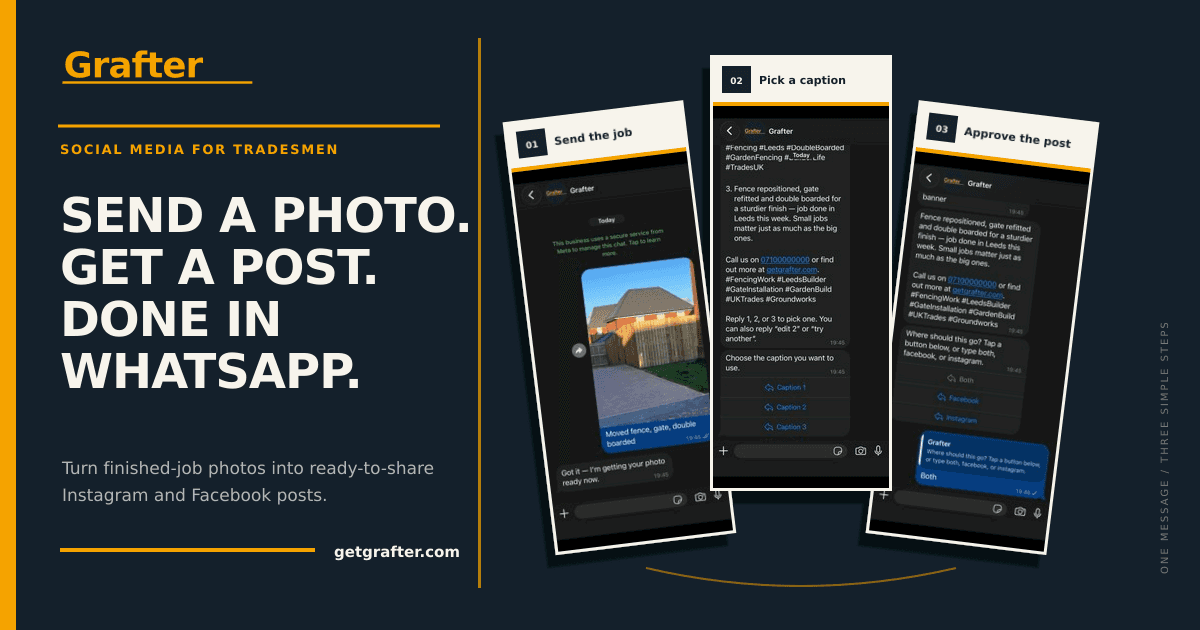
Local SEO is steady housekeeping, not a guaranteed shortcut. If you would rather spend less time turning finished jobs into social posts, Try Grafter on WhatsApp.
Google explains the main local ranking factors and its SEO basics.