
A tradesman website should answer four questions quickly: What work do you do? Where do you do it? Can I trust you with the job? How do I get in touch? Use this checklist to make those answers easy to find, especially for someone looking at your site on a phone.
You do not need a complicated website to start. Clear information, real proof and a working contact route matter more than decorative effects or a long list of search phrases.
Put the essentials near the top
On the first screen, state your trade, main service and broad working area. Make your phone number easy to tap. If you prefer enquiries by form or WhatsApp, label that option clearly and say what information you need to provide a useful reply.
Avoid a headline that says only “Welcome to our website” or “Quality you can trust”. A better example is: “Domestic electrician in [town] — repairs, lighting and rewires.” Use only services and places that genuinely apply to your business.
Make the services easy to understand
List the work you take on in plain language. A customer may not know trade shorthand, so explain what is included and what happens next. If two services involve different customers or processes, give each enough space to answer its own questions.
For example, a decorator could separate interior painting from exterior work if the preparation, access or season affects what a customer needs to know. You do not need a separate page for every small variation.
Add details you can stand behind: the types of properties you work on, whether you take on small repairs, and how customers can arrange a visit or quote. Do not promise a response time or emergency availability unless you can meet it.
Say where you work—without pretending to be everywhere
Name the town or region where you are based and the nearby areas where you regularly accept work. If the drive time or call-out area matters, say so in a simple way.
Do not publish a stack of near-identical town pages that only swaps place names. Each page should help a customer in that place with real, distinct information. Our local SEO guide for tradesmen explains the difference between useful area information and trying to game a map listing.
If you have an eligible Google Business Profile, keep its service details and contact information aligned with the website. See the Google Business Profile setup guide for the profile-specific rules.
Show proof honestly
Use your own photos of completed jobs where you have permission to share them. Add a short caption explaining what the work involved and the broad area. Do not use stock images as if they show your own work, and do not imply a result or qualification you cannot verify.
Mention trade memberships, registrations or qualifications only when they apply to the person or business doing the work. Where an official register exists, link to it so a customer can check. If you use customer reviews, present them honestly and do not edit them to change their meaning.
The job-photo guide for tradespeople covers framing, customer permission and details to keep out of a photo.
Make it easy to ask for a quote
Keep the contact route visible on service pages, not only on a separate contact page. If you use a form, ask only for details that help you assess the enquiry—such as the service, broad location and a short description. Do not make someone create an account just to ask a question.
Tell the customer what happens after they send it. For example: “I’ll check the details and get back to you to arrange a visit.” Make sure the form works on a phone and test it yourself after any site change.
If you send written quotes, explain what they include and how customers can ask questions. The trade quote checklist can help you make that next step clearer.
Check the basics before publishing
- Every important page has a clear title and one main heading that describes the page.
- Page addresses are short and understandable.
- Phone numbers, email addresses and forms work on a mobile.
- Photos load properly and have useful descriptions for people using assistive technology.
- The site uses secure HTTPS and does not show old prices, areas or opening hours.
- Links to related services and useful guides work.
Google’s SEO Starter Guide recommends descriptive titles and URLs, useful content and links that help people navigate. Those basics help visitors and search engines understand the page, but they do not guarantee a search position.
Review the site whenever your services, number or working area changes. Keep a short note of which pages generate suitable calls and quote requests, then improve the pages customers actually use.
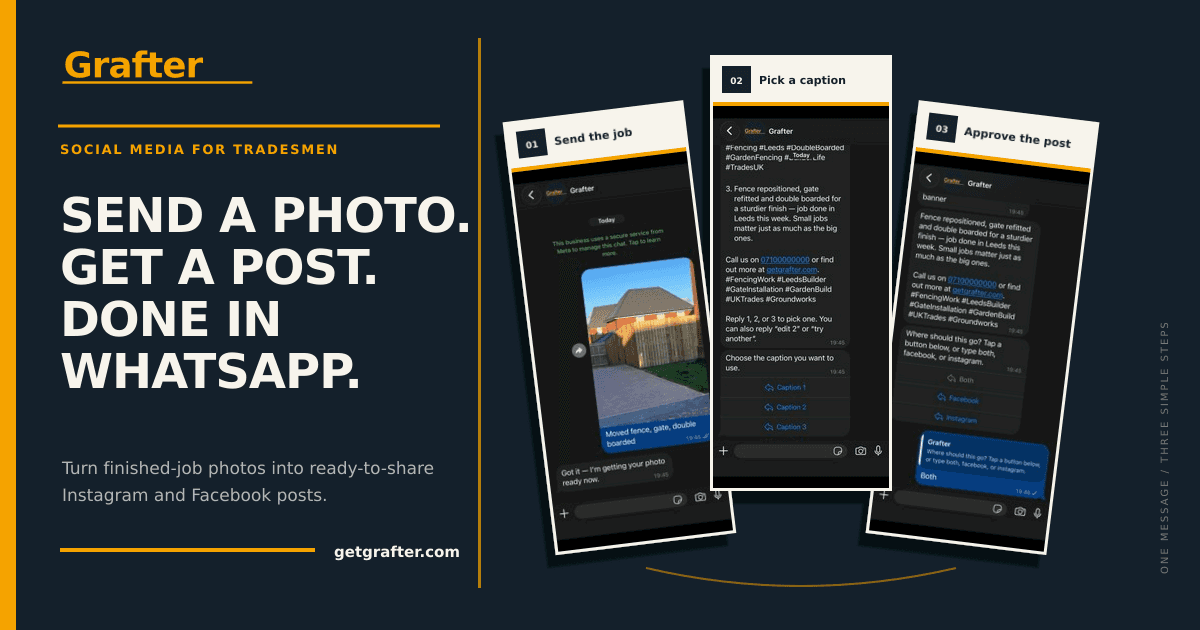
If you already have job photos but struggle to write social captions, Try Grafter on WhatsApp.