
When you are busy on site, “advertising” can sound like another bill and another job to manage. If you are looking for free ways to advertise a trade business, start with the basics. Some useful methods cost no platform fee: make your business easy to find, show real work, keep in touch with previous customers and ask for recommendations.
Free does not mean effortless. These channels take time, and none guarantees a booking. The practical goal is to help the right local customer recognise what you do, trust that you do it well and know how to contact you.
What “free advertising” really costs
An account or listing may be free to create, but it still takes time to write a profile, take photos, answer enquiries and keep details current. Some services also offer paid upgrades alongside free features. Check the current terms before signing up, and do not give payment details to a directory just to claim a basic listing unless you understand what you are buying.
Start with the assets you already have: a clear business name, a mobile number, a short description of your main work, a service area and a small collection of job photos you have permission to share. Make sure the phone is answered or has a useful voicemail. Promotion cannot help much if a good enquiry gets no reply.
Make a Google Business Profile useful
Google says eligible businesses can manage a Business Profile on Search and Maps at no charge (official setup guidance). A tradesperson who travels to customers may qualify as a service-area business; a shopfront is not always required. Check Google’s service-business eligibility guidance before creating a listing.
Use your real business name, choose the closest category for the work customers mainly hire you to do, enter a realistic service area and add accurate contact details. If customers do not visit your home, follow Google’s rules for hiding the address. Do not create extra profiles for separate towns or stuff your business name with search terms.
Add genuine photos of completed work, answer common questions clearly and check opening hours when they change. Ask customers for honest reviews without offering a reward. Our Google Business Profile guide for tradespeople covers profile setup, address privacy, photos and replies in more detail.
Use social media as a work portfolio
A Facebook Page or Instagram professional account can show the standard and range of your work. You do not need a studio shoot. A clean photo of a finished fence, repaired roof, fitted kitchen or replastered room, paired with one factual sentence, is often more useful than a graphic full of claims.
Give each post enough context to make sense to someone who has never met you: what the job was, the broad area, a detail that mattered and what kind of work you take on. Get the customer’s permission before showing their property, and remove house numbers, faces or paperwork that should stay private.
Choose a pace you can maintain. One useful post every week or two is a more realistic starting point than promising daily updates and stopping after a fortnight. A photo can be reused in a portfolio later, but change the caption so every post does not look copied and pasted. See how to get more building jobs through social media for a straightforward posting approach.
Join local groups without acting like spam
Neighbourhood Facebook groups and community forums can put you in front of nearby residents, but each group has its own rules. Some allow recommendations only in a weekly thread; others do not allow business promotion at all. Read the rules before posting and ask an administrator if the policy is unclear.
When promotion is allowed, make the post specific and useful. “Local electrician available” gives little reason to choose you. A short explanation of the service, a genuine example and a way to contact the business is clearer. Do not repeat the same advert every day, post irrelevant offers in a discussion or message members who have not asked for contact.
You can also be helpful without making every contribution an advert. Answer a practical question within your competence, explain when a job needs an in-person inspection and be honest if it is outside your trade. If someone asks for a recommendation, respond politely and let them decide. Trust is easier to damage than to build.
Ask for referrals and honest reviews
People who have seen your work can introduce you to neighbours, landlords or other trades. After a job is complete, thank the customer and ask whether they would be comfortable recommending you if someone they know needs similar work. Make it easy for them to share your business name or contact page.
If you ask for a public review, ask for an honest one, not a positive one. Google prohibits incentives for posting, changing or removing a review. UK consumer protection rules also prohibit fake reviews and certain misleading review practices; the Competition and Markets Authority publishes guidance for businesses on fake reviews. Do not write a review for a customer, pressure them to change a low rating or offer a discount in exchange for five stars.
Respond calmly to feedback. A brief, personal reply can show that you take the work seriously, but avoid posting private details about a job or customer to defend yourself publicly.
Make your existing work do more
Your camera roll may already contain a useful portfolio. Sort photos into simple folders by trade or job type so you can find relevant examples when a customer asks. Pair before-and-after shots from roughly the same angle, if you took them and have permission to share both. Do not edit a photo in a way that misrepresents the result.
Use the same proof in more than one appropriate place: a social post, a website portfolio, a quote follow-up or a printed estimate. Add a plain description such as “replaced damaged fence panels in [area]” rather than an unsupported claim like “the best fence installer in the county.” For a practical method, read our guide to before-and-after photos.
Build a small online home for your business
A simple website or landing page gives customers one stable place to check services, areas covered, contact details and selected work. A free website builder may offer a basic page on its own address, while a custom domain, email, hosting extras or design help may cost money. Check the terms before relying on a “free” offer.
If a website is not realistic yet, keep your business profile and social page consistent. Use the same trading name, phone number, description and service areas where each platform allows. Inconsistent details can confuse a potential customer, especially when they are comparing several local businesses quickly.
Try referrals from nearby businesses
Think about who meets your customers before or after you do: kitchen designers, estate agents, property managers, builders, decorators, suppliers or another trade whose work complements yours. Introduce yourself and explain the jobs you are suited to, the areas you cover and how you handle referrals.
Do not assume a referral arrangement is automatically free or suitable. A trade association or directory may charge a membership fee, and a formal referral deal may need clear terms. Start with a professional relationship, reliable handovers and a quick thank-you when someone sends work your way. Never imply that another business has endorsed you unless they have agreed.
Measure enquiries, not likes
Keep a short record of where each new enquiry came from: Google, a local group, a past customer, a social post, a neighbour or another trade. Note whether it was a suitable job, whether you quoted and whether it turned into booked work. A simple notebook or spreadsheet is enough.
This stops you spending all your effort on the channel with the most visible activity rather than the one that produces work you actually want. If you receive many enquiries but few suitable jobs, clarify your services and service area. If people view your posts but do not contact you, make the next step easier to understand. Change one thing at a time so you can tell what helped.
A practical four-week starting plan
In week one, check that your business name, phone number and service areas are accurate wherever customers look. Claim or complete an eligible Google profile rather than making a duplicate. In week two, choose a few strong, permission-cleared photos and write a short caption for each. In week three, use a consistent, optional request for an honest review or referral after completed jobs, without offering an incentive or filtering for positive feedback. In week four, share one useful post where local promotion is permitted and review the enquiries you received.
Keep the parts that lead to suitable conversations. Drop tasks that take time without helping customers find or understand your business. Free promotion works best when it is steady, accurate and connected to how you already deliver a good job—not when it becomes a second full-time role.
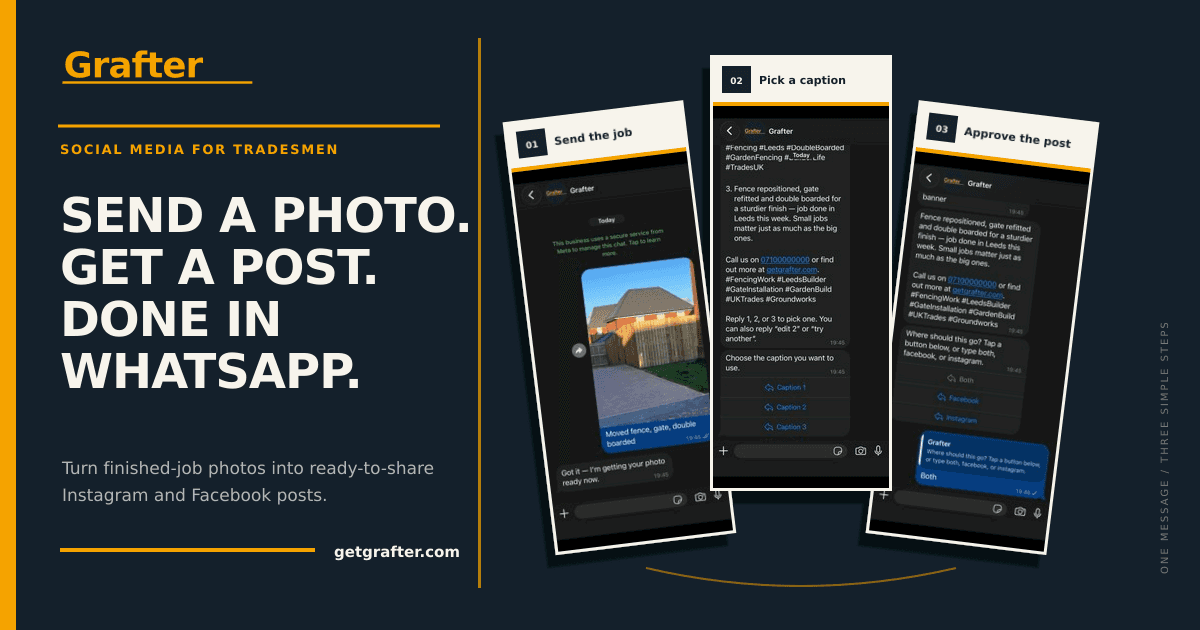
If turning finished-job photos into social captions is the part you keep putting off, Grafter can draft options for Facebook and Instagram from WhatsApp. It does not replace your profile, referrals or customer service. Try Grafter on WhatsApp.