
Word of mouth marketing for tradesmen is not an either-or choice between referrals and social media. A recommendation can put your name in front of a homeowner at exactly the right moment. A social profile can then help that homeowner see what work you do, where you cover and how to get in touch.
Both channels can support trust, but they do not work in exactly the same way. Referrals are personal and often begin in a conversation. Social media is a public record of your work that may be found, shared or checked later. A practical local marketing plan gives each channel a clear role.
What word of mouth does well
A recommendation from a neighbour, family member, landlord or another trade comes with context. The person can explain what job you did, whether you arrived when expected and how the work went. That detail may help a potential customer decide whether to call.
But word of mouth can be hard to control. It depends on people remembering your name, knowing what services you want and having someone to recommend you to. A satisfied customer may want to help but not know how to pass your details on. A referral can also be incomplete: the customer might remember your first name but not your business name or area.
Make it easier without turning the relationship into a sales script. Give customers a clear business card, contact link or profile address at handover. Explain the work you are best suited to and the locations you cover. If a neighbour asks about the job, the customer can share the right information without trying to describe every service from memory.
What social media does well
A Facebook Page or Instagram profile can act as a portfolio and a current contact point. Someone who has heard your name can check examples, services, recent activity and the best way to reach you. Someone who has not met a past customer may discover a post shared by a neighbour or a local group.
Social content gives you a way to show, not just tell. A finished-job photo, a progress update or a short explanation of a detail can help a potential customer understand the work. Use your own images, describe them accurately and get permission before sharing a customer’s property.
Social media does not guarantee local reach or enquiries. A post may be seen by existing contacts, people outside your service area or very few people at all. Its role is to make useful proof available and give customers something easy to share. For a simple starting point, read how to get more building jobs through social media.
How the two channels reinforce each other
Imagine a homeowner receives your name from a neighbour. Before calling, they search for your business or ask for your Page. They see a recent example similar to their job, a clear description of the service and a working contact route. The referral made the introduction; your online information helped them check whether the work looks relevant.
The reverse can happen too. Someone sees a post about a kitchen installation but does not need a fitter yet. Months later, a neighbour asks for a recommendation and the person remembers your work or forwards the post. The customer may not treat that social view as the reason for choosing you, even though it helped them remember the business.
This means attribution is not always neat. Ask new customers how they heard about you, but allow more than one answer. Record “neighbour and Facebook Page” if both played a part rather than forcing a single source. Over time, those notes can show patterns without pretending that every booking came from one post.
Turn good service into a referral routine
Referrals begin with the work itself: clear expectations, respectful communication and a tidy handover. Explain what is complete, what remains, how to operate or care for the installation where relevant and how to contact you if a question comes up. Do not promise more than the job includes.
At the end, thank the customer and let them know what kind of work you take on. A simple line can be enough: “If anyone nearby needs similar fencing work, you’re welcome to pass on my details.” It is an invitation, not a demand. If they are not interested, leave it there.
Ask for an honest public review separately from a referral. Do not offer money, a discount or a free service in exchange for a Google review, or ask the customer to change or remove a negative review. Our customer reviews guide for tradesmen explains neutral requests and professional replies.
Make your social profile referral-ready
When someone is referred to you, they should be able to verify the basics quickly. Make sure the business name, service description, contact details and broad service area are current. Pin or feature a useful example if the platform offers that option, but do not let a pinned availability post stay up after the dates have passed.
Use clear captions that explain what each photo shows. “Another happy customer” says little about the work. “Replaced a damaged garden gate in [area], including new hinges and a secure latch” gives more context, if that is what you did. Avoid including the customer’s full address or details about when a property is empty.
Do not try to make every post go viral. Local relevance matters more than a large audience far beyond your working area. Share real jobs, occasional practical advice and accurate availability. Our free advertising guide for UK trade businesses covers local groups and other no-fee ways to be visible.
Build relationships with complementary trades
Another source of word of mouth is a professional who does work before or after yours. A kitchen fitter may know a plasterer or electrician; an estate agent may hear that a property needs repairs; a landscaper may work alongside a fencing contractor. A referral relationship works best when each person understands the other’s scope and reliability.
Start with a short, clear introduction: the work you take, the areas you cover, the jobs you do not take and the best way to refer someone. Follow through promptly when a lead is sent. If you cannot take the job, say so quickly so the customer can find another option.
Do not imply that a trade partner guarantees your work unless that is an agreed arrangement. If a referral involves payment or another benefit, be transparent with the people involved and get clear terms. A relationship built on accurate handovers is more sustainable than a vague promise to “send work both ways”.
Share proof without oversharing
Photos, customer feedback and job descriptions can help social posts support referrals, but they also create privacy responsibilities. Ask before taking or posting identifiable pictures inside a customer’s home. Remove addresses, children, faces, alarm details, paperwork and number plates where they are not needed. Do not share private messages as testimonials without permission.
Use before-and-after images that show the same job and do not hide defects. If you describe materials, methods or qualifications, check the wording. A potential customer should not be left believing you offer a service or guarantee that you cannot provide.
Keep a simple referral and social tracker
A spreadsheet can help you see how new work arrives. Record the date, customer’s broad area, job type, referral source, social touchpoint if mentioned, quote result and whether the work was suitable. Avoid storing more personal information than you need, and keep the file secure.
Review it every month or quarter. Which referrals led to work you want more of? Which social posts prompted useful questions? Are several customers mentioning the same partner? If one activity takes a lot of time but does not lead to suitable conversations, adjust it rather than continuing out of habit.
A practical weekly routine
At the end of one job each week, save a permission-cleared photo and note what you completed. At handover, make the next step clear and ask for an honest review only in a neutral way. Set aside a short block to publish one useful social post or update an existing profile. Once a month, thank a trade partner who sent a suitable enquiry and check the referral tracker.
This routine keeps the channels connected without requiring daily posting. If you have no shareable photo that week, a short answer to a common customer question can still be useful. Do not invent a story or manufacture urgency to fill a posting schedule.
Word of mouth vs social media is therefore a false choice. Referrals introduce you; social proof helps people check you; good work gives both something genuine to say. Keep the details accurate, make it easy to contact you and use the enquiries you actually receive to decide where to put your time.
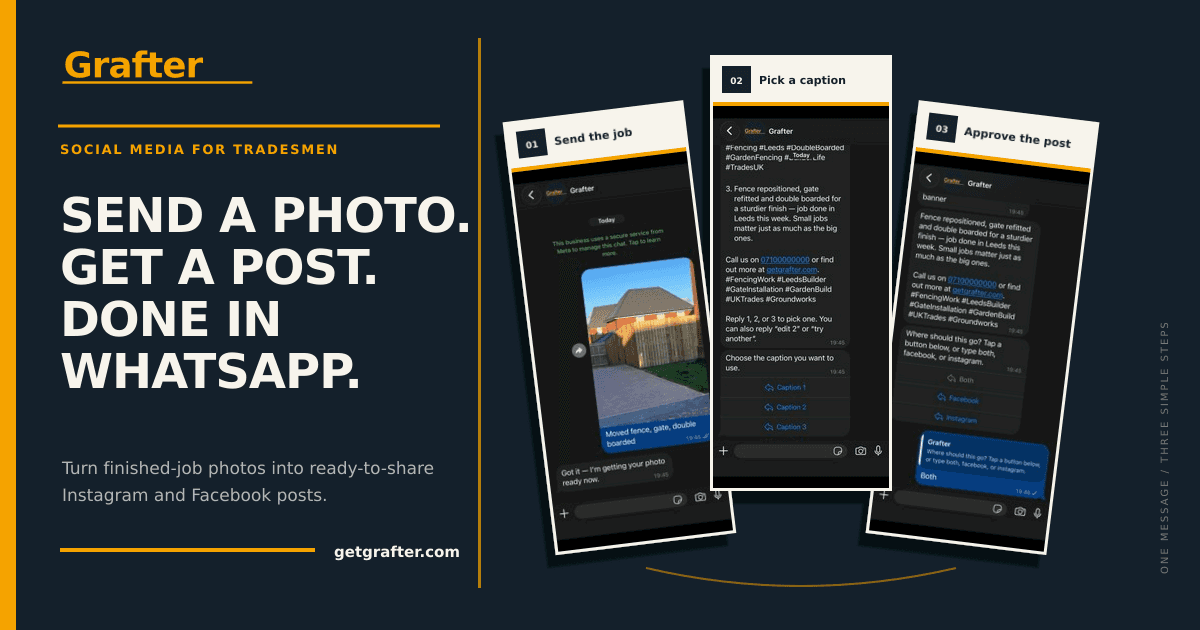
If caption writing is the part that makes your completed jobs hard to share, Grafter can draft Facebook and Instagram caption options from a job photo and a sentence over WhatsApp. You stay in control of the wording. Try Grafter on WhatsApp.