
“How much should a tradesman spend on marketing?” is a sensible question, but a single percentage or monthly figure cannot answer it for every business. A one-person electrician with a full diary has different needs from a new landscaping firm trying to fill a quiet season. The right budget depends on cash flow, capacity, job value, local demand and how well you can track enquiries.
Instead of copying a generic benchmark, set a limit you can afford, choose one activity you can measure and decide in advance what evidence would make you continue, change or stop it.
Start with capacity and cash flow
Marketing only helps if you can take on the work it generates. Before paying for ads, directory listings or lead services, ask how many extra jobs you could handle without delaying current customers or lowering the standard of the work. If the diary is full for months, the priority may be better job selection or a waitlist, not more leads.
Set aside money only after essential operating costs and tax obligations are accounted for. Keep the marketing pot separate in your bookkeeping so subscriptions and invoices are visible. If income is seasonal, avoid committing to a year-long contract based on a strong month. Check cancellation terms, renewal dates and whether an advertised “trial” becomes a paid plan.
Define the job you want more of
“More work” is too broad to guide spending. Name the service, customer and area you want to reach. A plumber may want planned bathroom installations rather than emergency call-outs. A builder may want extensions within a practical drive rather than small repairs spread across a wide region. The clearer the target, the easier it is to compare the quality of enquiries.
Write down what makes an enquiry worth following up: suitable location, project type, likely start date, access, budget range if known and whether it fits your skills. Do not collect unnecessary personal information. This gives you a consistent way to judge a channel rather than deciding based on a busy inbox.
Calculate the value of a booked job
Do not compare marketing cost with the quoted price alone. Revenue is not the same as profit. A job’s contribution is what remains after the direct costs you incur to complete it, such as materials, subcontractors, disposal and other variable expenses. Your own labour and overheads also matter when deciding whether a job is worth taking.
Use a simple chain:
- Cost per enquiry: total marketing cost divided by relevant enquiries.
- Quote rate: quotes sent divided by relevant enquiries.
- Win rate: jobs booked divided by quotes sent.
- Marketing cost per booked job: total marketing cost divided by jobs reasonably attributed to it.
For a clearly labelled illustration, suppose you spend £120 on a local promotion and receive four enquiries that fit the service and area. That is £30 per suitable enquiry. If one becomes a booked job, the cash marketing cost attributed to that job is £120 before counting your time. Whether that is worthwhile depends on the job’s contribution, the likelihood of repeat work and your alternative uses for the money. The example is arithmetic, not a typical trade-business result.
Value your time as well as cash
A “free” channel can still consume hours. Time spent making posts, answering poor-fit leads or maintaining a directory listing is time not spent quoting, doing chargeable work or resting. You do not need to price every minute precisely, but include a sensible estimate when comparing channels.
For example, record the subscription or ad spend, the hours needed to set it up, time spent on enquiries and any follow-up. If you are comparing a paid service with doing it yourself, compare the full effort, not just the monthly charge. Be honest about whether an activity replaces something you already do or adds another task.
Choose a starting budget you can afford to test
There is no universal marketing percentage that is automatically right for a UK tradesperson. Choose a monthly cap that would not put wages, materials, insurance or tax payments at risk if the promotion produced no jobs. Keep the first test small enough that a poor result is affordable, but long enough to gather useful evidence.
Before you spend, write a one-sentence test plan: “I will spend up to £X over Y weeks to promote [service] in [area], and I will record suitable enquiries, quotes and booked jobs.” Set an end date and a review date. Do not keep adding money simply because the first week was quiet or because a platform suggests increasing the daily budget.
Build a low-cost base before buying reach
Make the basics accurate before paying to send people to them. Check your business details, service descriptions, contact route and photos. An eligible service-area business can use a free Google Business Profile, while Google Ads and other paid placements are separate products. Our Google profile setup guide for tradespeople explains what to check.
Keep a small portfolio on your website or business profiles. Invite customers to leave honest reviews through a consistent, optional process without incentives, and collect permission before sharing job photos or quotes. If your social pages are empty, start with one useful post a week rather than paying to boost an unclear message. The free advertising guide for UK trade businesses lists practical no-fee channels.
Test one paid channel at a time
If the free basics are in place and you have capacity, choose one paid channel that reaches the type of customer you want. It may be a tightly limited local search advert, a properly reviewed directory listing or a small social campaign. The right option depends on the service and how customers search; do not assume a platform recommendation is independent advice.
Check what you are paying for: clicks, calls, leads, a listing, a fixed campaign period or a subscription. Ask whether leads are exclusive, how refunds or invalid enquiries are handled and whether you can set geographic limits. Read the contract and cancellation terms. Avoid suppliers who promise a fixed number of jobs or guaranteed top rankings without explaining conditions.
Do not start several campaigns at once if you cannot tell them apart. Use a dedicated landing page, a simple source question or campaign-specific contact path where practical. Keep the information accurate and do not imply that a paid advertisement is an independent review or recommendation.
Track from first contact to completed work
A spreadsheet with one row per enquiry is enough to begin. Record the date, source, service, area, whether it was suitable, whether you quoted, the result and any follow-up required. Use a business phone or email consistently so messages do not disappear into personal accounts. If the customer is unsure, mark the source as unknown instead of guessing.
Review the numbers monthly, not after every click. Look for patterns: which source brings jobs you want, how quickly you respond, which jobs turn into quotes and which quotes are accepted. A channel may assist the decision without being the last touch, so record what the customer says and avoid claiming perfect attribution.
Know when to increase, change or stop
Consider increasing a budget only when you have repeatable evidence that the channel brings suitable work, you can fulfil that work and the contribution supports the full cost. Increase gradually and continue tracking. A good result in one month does not guarantee the same result in a different season or location.
Change the offer or landing page if enquiries are the wrong type. Change the targeting if the location is too broad. Stop or renegotiate if the contract is unclear, the enquiries are consistently unsuitable or the real cost is higher than the value you can reasonably attribute. Do not let sunk costs decide; money already spent cannot be recovered by spending more.
Plan for quiet and busy periods
Trade demand can be affected by weather, project lead times, school holidays, local building activity and the kind of work you do. Do not assume a slow week proves that a channel has failed, or that a busy month will repeat automatically. Compare like with like where you have enough records, and write down unusual circumstances such as a large referral or a temporary closure.
If you expect a quieter period, consider whether you need awareness now for jobs that will start later. If you are already booked out, pause campaigns that create more enquiries than you can handle and keep a clear waitlist. Budget decisions should reflect when customers enquire, when work can start and when cash is actually collected—not just the date an advert runs.
Common budget mistakes
Avoid confusing turnover with available profit, copying another business’s spend, signing up for a long contract before a short test and judging advertising only by likes. Do not buy fake reviews or pay for a “guaranteed” Google position. Keep invoices and records, and ask an accountant about tax treatment rather than assuming every marketing expense receives the same treatment.
Finally, protect time to do the work well. The best marketing budget is not the largest one. It is a controlled amount connected to a clear service, a real customer, a measurable follow-up and enough capacity to deliver what you promise.
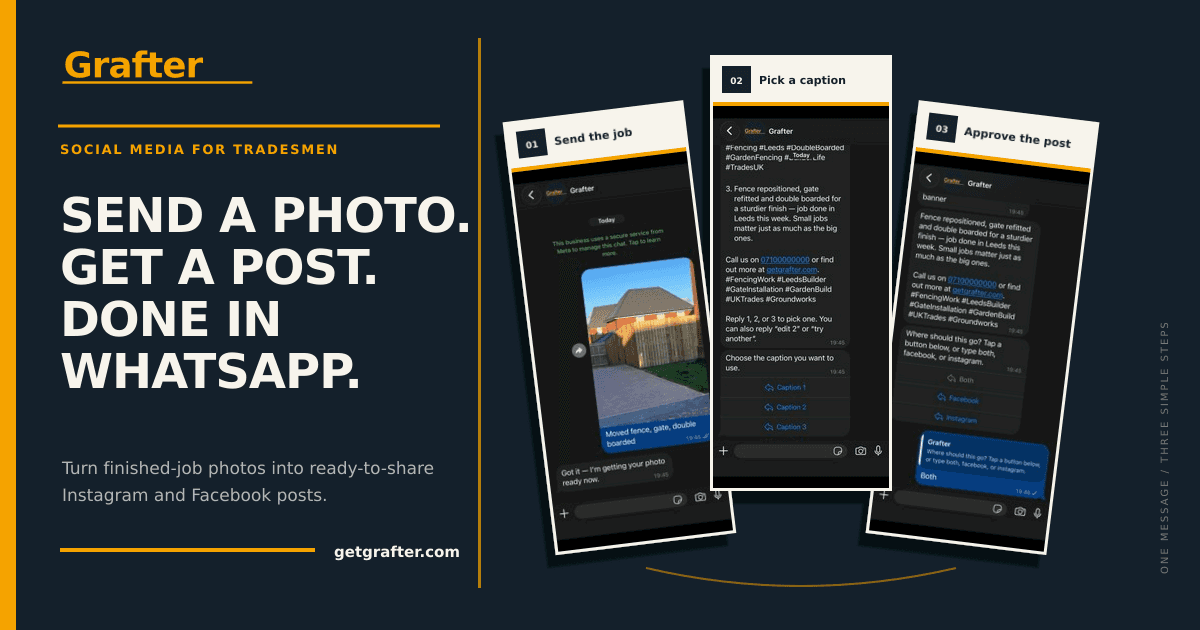
If social posts are part of the plan, Grafter can help turn job photos into caption options for Facebook and Instagram over WhatsApp. It is one workflow, not a substitute for tracking whether your marketing produces profitable work. Try Grafter on WhatsApp.